Put a soil moisture sensor under tree crops and it answers one question: has the soil where feeder roots drink dried enough that the next irrigation should start? Probe placement follows from that. Avocado, coffee bush and mango do not hold feeder roots in the same band. A wet bulb under a dripper is not shaped like the root zone, and a reading taken against the trunk describes soil the tree barely touches. This piece works through that placement call for a grower with a phone and a block to water on Monday. It also says plainly which crops the sources cover, because for two of the four named in the brief they cover nothing.
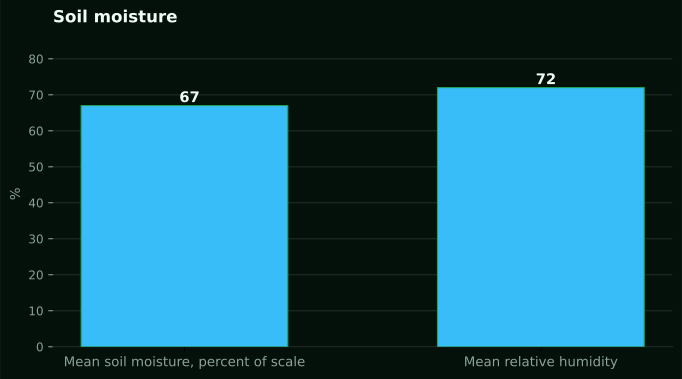
Measured by NuaSense weather stations and soil probes on Kenyan farms, over the period stated with each figure. Past readings, not a forecast.
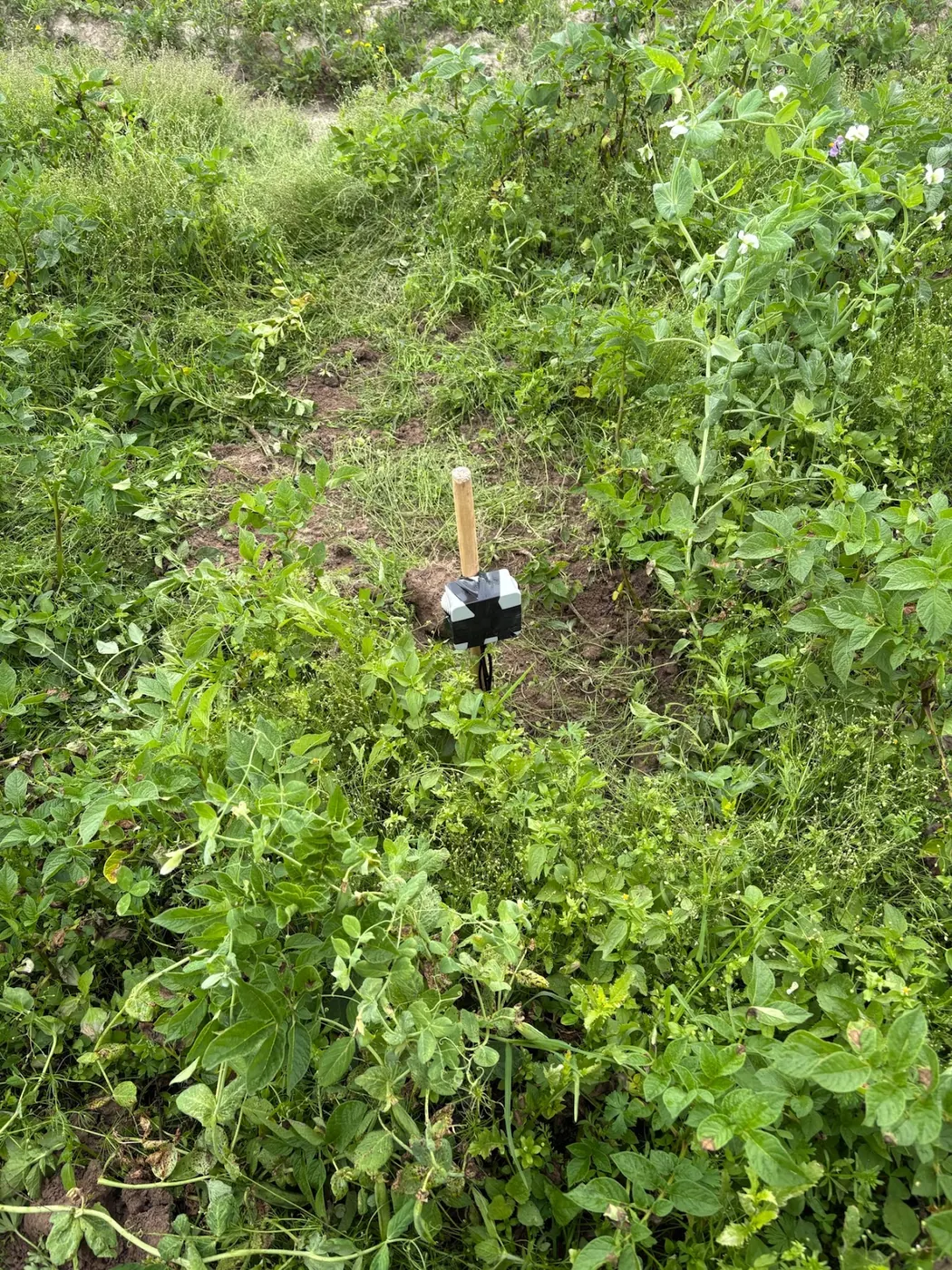
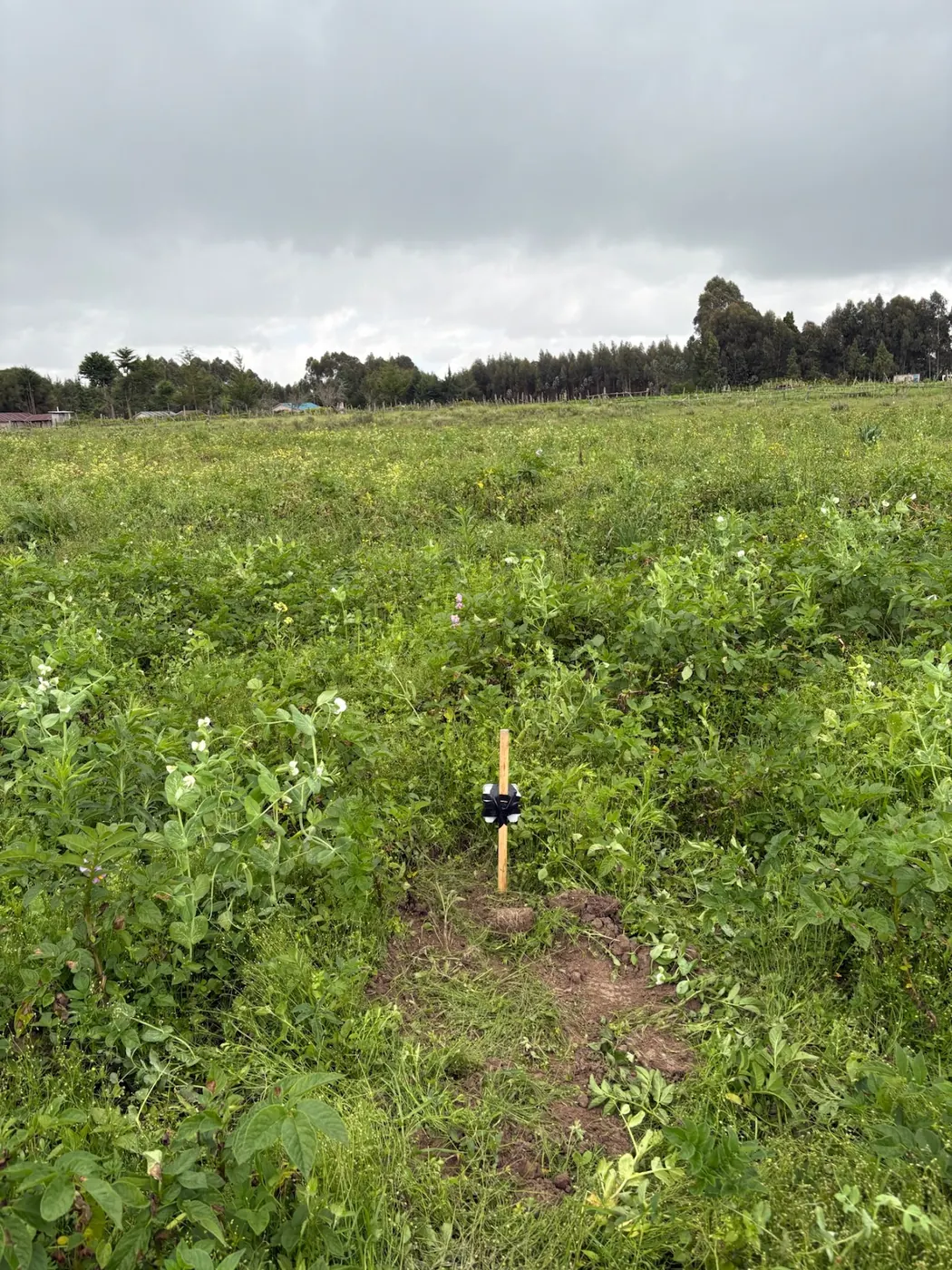
Three places to put the probe, and one of them is wrong
In the field, the choice comes down to three spots. Against the trunk, because that is where the tree is. Under the emitter, because that is where water lands. Out towards the canopy edge, because that is where feeder roots are supposed to be. Growers pick the first spot because it is easy to find again and out of the slasher's way. That spot is wrong. UC Riverside's avocado guidance keeps mulch and gypsum 6 to 8 inches off the trunk and builds its planting mound 3 to 5 feet around. That tells you the soil at the collar is managed as a zone to keep clear, not as the place the tree drinks.
Emitter against canopy edge is the real contest, and how you water the block settles it. Where a dripper supplies the water, roots gather under the dripper. The University of California irrigation guidance says root depth varies between fields with irrigation pattern for exactly that reason, so installation has to be adjusted to the field rather than copied from a chart. On a Kenyan block with hand-laid line, one emitter per tree and wide spacing, roots will crowd the small wet bulb, and the probe belongs inside it. Under micro-sprinkler or basin flooding, the wetted area is broad, roots spread with it, and a probe part way out from the trunk inside the wet area represents the tree better. To find the position, water, wait a day, and dig to see where the soil is wet and where there are white root tips. No source in this bank gives a distance in metres or feet for any tree crop, and this article will not invent one.
Six inches: the only tree-crop depth the sources give
For avocado, the depth question has an unusually clean answer. That same UC Riverside avocado FAQ describes the avocado as a shallow-rooted tree with most of its feeder roots in the top 6 inches of soil. A shallow probe has to represent that band. Bury it at the depth you might choose for maize or a deep-rooted fruit tree, and it spends its life reading soil the avocado uses only as a reserve. It calls for irrigation long after the feeder roots have gone dry. Under avocado, a shallow probe is the trigger. No argument is needed.
Now the transfer. That observation comes from a California variety collection, on Californian soils under a Californian irrigation regime. Nothing in the bank measured avocado roots in Kenya. What carries across is anatomy: feeder roots that sit high and die in waterlogged or compacted ground. That is why the same source wants heavy clay planted on a mound 1 to 2 feet high and warns against gravel or planting mix in the hole, because the textural difference between root ball and bulk soil causes water movement problems. What does not carry across is the climate behind the watering numbers. A mature tree is given a rule of thumb of about 20 gallons a day in the irrigation season, and a new transplant about 1 gallon a day on the coast, meaning the Californian coast. Those figures are for checking a probe's arithmetic later in this piece, not a Kenyan schedule. On a highland loam or a coastal sand the feeder roots will still sit high, but how fast the top 6 inches dries is a thing to measure, not to quote.
A deeper probe audits the irrigation, it does not trigger it
Two depths per location is the design every extension service in this bank converges on. The University of California guidance on when to irrigate is clearest about the division of labour. A shallow sensor goes where most active roots are. A deeper sensor goes towards the bottom of the root zone. Only the shallow sensor carries the irrigation threshold. The deeper one assesses how much water reached the bottom of the root zone, and moisture down there is treated as a reserve the tree draws on when shallower soil runs short. One check is easy to apply on a phone: the deeper sensor's readings should always be lower than the shallow one's. If the deeper trace sits above the shallow one for days, something is off, usually poor drainage at that depth or a gap around the probe.
This is a two-probe, one-threshold design. Growers who buy two depths tend to invent a second threshold for the deeper one and then water whenever either looks dry. That doubles irrigation events for no gain. After an irrigation, the deeper probe tells you whether water got past the feeder roots. If it never rises, the run was too short or the emitter is clogged. If it rises sharply every time, water is being pushed below the roots. Between irrigations its slow decline shows how much reserve is left. A NuaSense soil sensor is built on exactly this pattern: a shallow probe and a deeper probe, each with a moisture and a soil temperature channel, burial depth chosen at installation by crop and rooting pattern rather than fixed at the factory. Our soil moisture sensor page describes the hardware; this piece is about where to put it.
Macadamia and coffee: no table exists, so dig one
Here is the gap, stated plainly. Not one source in this bank names macadamia or coffee. There is no feeder-root depth, no trunk distance and no threshold for either crop. Any article that gives you one for Kenya is quoting a source it has not shown you or making it up. Since the brief asks for both crops, the honest answer is a method, not a number.
That method comes from material written for other crops. When the feel method is used, Oregon State's guide to soil moisture monitoring has soil evaluated in 1-foot increments down to the effective rooting depth, and that increment works for a root survey too. Water one representative tree the way the block is normally watered. Wait a day. Dig a narrow pit from the wetted edge inward. At each foot, note where fine white roots are dense, where they thin, and where the soil stops being moist. California's point holds in full: roots accumulate where water is. A coffee bush under drip since planting and one grown on rain will not share a root profile. A terraced macadamia with a basin around it will differ from one on flat ground under micro-sprinkler. Put the shallow probe in the band where roots are dense, and the deeper probe at the bottom of that band where roots are still found. Then apply the California rule: blocks that differ in cultivar, soil type or planting date each get their own sensors. A young coffee block and a bearing block are two installations. It is slower than reading a chart, and it is the only version of the number that is true on your soil.
Trunk distance and probe distance are two different numbers
UC Riverside keeps two distances apart. Conflating them is the commonest placement mistake. One distance is how far things stay from the trunk: 6 inches of woody mulch held 6 to 8 inches off the stem, gypsum at the base of the mound, a mound 3 to 5 feet around. That is horticulture. It keeps the collar dry and stops the root ball drowning in heavy clay. Where the sensor sits is a different distance. The only instruction the sources give for it is functional: in the wetted root zone, where most active roots are, in soil that is actually irrigated.
Growers talk about the dripline, the ring on the ground below the canopy edge, as if it were a standard probe position. No source in this bank says probes go there, and this piece will not say it either. On a mature tree with a wide canopy and one emitter near the stem, the dripline may be dry and rootless. On a young tree it may fall inside the mound. Roots follow the water, not the leaves.
Find the wetted edge first. Run the irrigation, walk the row, and press a trowel into the soil at increasing distances from the emitter until it comes up dry. Put the probe well inside that edge, in soil wetted on every run, and away from the trunk. Under basin or furrow the same test applies: find where water reaches on an ordinary run, not a long one. Arizona's guide to maintaining field sensors lists uneven wetting from drip and micro-sprinkler and shallow sampling depth among the things that complicate interpretation. A probe at the fringe of the bulb is wet on a long run and dry on a short one. Its trace becomes noise. Inside the bulb it reads what the roots feel.
Start on the probe, stop on the arithmetic
Two main sources in this bank disagree about what a probe is for, and that disagreement is useful. California says sensors should not decide when to stop irrigating. Water from drip tape or micro-sprinkler follows a non-uniform pattern, so duration should come from the ET-based method. New Hampshire's extension fact sheet credits sensors with helping growers set both frequency and duration. It reports that its monitoring found cycles running more often and longer than needed to reach field capacity, so on many occasions readings led growers to wait an extra day or two. Both are extension services reading the same kind of instrument. What differs is how much they trust the probe to see.
For a tree under a single emitter, the California position is safer. One probe in one wet bulb cannot tell you whether the other side of the tree got water. It can start the irrigation. It cannot honestly end it. Duration has to come from what the tree used and what the emitter delivers, and the way to join those is to turn a reading into a depth of water. Oregon State's monitoring guide gives the conversion: a volumetric water content of 0.25 cm³/cm³ across a 12-inch root zone is 0.25 multiplied by 12 inches, which is 3 inches of stored water. That arithmetic lets a grower check the Californian 20 gallons a day against what the probe says left the soil, provided the probe reports calibrated volumetric content. Ours does not. It reports percent of sensor scale. The mean of 67 percent across 15 NuaSense probes over 09 October to 08 November 2026 is a scale position, not a water content, and must not go into that sum. Reference ET0 from our stations averaged 1.5 mm a day over the same period, which is reference demand, not what a tree used.
Forty kilopascals is two instructions on two soils
Thresholds travel badly, and New Hampshire's numbers show why. On granular matrix sensors reading in kPa or centibars, where zero is saturated and fifteen is somewhat drier, the fact sheet puts the decision to irrigate in most soils other than heavy clay at 20 to 40 kPa. Then comes the catch. A reading of 40 kPa means about 50 percent of the water is still plant-available in a sandy loam but only 35 percent in a loamy sand. Same probe, same number, two instructions. For drip it advises starting before plant-available water falls below 80 percent, which in the sandy loam example is 17 kPa. Calibration is the soil, not the sensor.
That matters on a Kenyan block whenever the planting crosses a soil boundary. A threshold borrowed from a neighbour or a vendor's leaflet was measured on a soil that is not yours. Texture and water-holding figures a dashboard attaches to a location, in our case from iSDA Africa and SoilGrids map layers, are modelled values of around 2016 vintage and not a test of that field. So they tell you which way the correction runs, not its size. Our piece on meter versus buried probe readings laid out the honest route: read the probe, then open the soil beside it and judge by hand until you know what each scale position looks like in your own ground. On the California tensiometer scale, ideal moisture after irrigation is approximately 0 to 5 centibars. The instrument is most accurate from 0 to 40 centibars, and one that reaches 90 centibars breaks tension and must be refilled. A tensiometer under a tree allowed to dry that far has already failed the tree. The usable band is narrower than the brochure suggests.
Hand, tensiometer, matrix block, buried probe: side by side
Four ways to answer the Monday question, with what each one costs and what it buys you. The prices are ranges or published figures from the bank, nothing more.
- Squeeze test and feel: costs nothing. UC Riverside says soil from around the roots that still holds the impression of a hand when squeezed still has enough water, and Oregon State puts the feel and appearance method within approximately 5 to 10 percent of volumetric moisture depending on texture and operator skill. Buys a judgement at the moment you dig. Does not buy a trace through the night or a record for a second block.
- Tensiometer: a water column in a tube. Most accurate from 0 to 40 centibars, breaks at 90 and needs refilling. Buys an honest reading of how hard roots are pulling, with no battery. Does not buy a dashboard and does not tolerate neglect.
- Granular matrix sensors with a handheld reader: New Hampshire's setup. At the time of that publication the digital reader cost 210 US dollars and each sensor 36 US dollars; American prices at that date, not current and not in shillings. Buys a cheap second and third point. Does not buy remote reading.
- Buried wireless probe at two depths: a NuaSense soil sensor is KES 7,000 excluding taxes, the two-moisture, two-temperature variant KES 9,000, the EC-capable version KES 10,000, each needing a NuaSense weather station at KES 30,000 excluding taxes to carry readings to the internet about every 10 minutes. Buys a trace you can read from town and compare block to block. Does not buy calibrated volumetric content.
Our position: if you have one tree block on one soil and you water by hand or off a single valve, don't buy a probe yet. Squeezing soil costs nothing and lands within the accuracy the sources give for feel, so the money is better spent using a spade to find the wetted edge and the root band. A probe starts to pay when several blocks on different soils or of different ages have to be compared, when the person deciding is not on the farm, or when a block gets watered at night with nobody there to squeeze anything. The station is the big line in that budget, and it is a weather station in its own right, so the arithmetic shifts for a farm that already wants ET0 and rainfall. If budget is the constraint, start with NuaSense's post on IoT in Kenyan agriculture, which covers which low-cost sensor setups smallholders have actually afforded and what mobile platforms do with the readings.
Failures are physical before they are electronic
When a probe under a tree returns a number nobody believes, the circuit is seldom the problem. Arizona's guide to field-installed sensors lists the usual failures: corrosion on the probe, mineral buildup, damaged cables, a sensor knocked out of place, trampling, rodents, a flat battery and lost wireless connection. Under tree crops, expect trampling and displacement. The probe sits in exactly the strip where pruning crews, harvest crates and the slasher pass, and cables under mulch are where rodents work. A better brand cures none of this. A routine does.
New Hampshire covers the installation side: good soil contact is essential, granular matrix sensors need the recommended wetting and drying cycle before they go in, and the lead runs up a length of PVC pipe, capped to keep moisture out. That pipe also stops a crew standing on the probe. Arizona adds the step growers skip: sensors drift and need recalibration, checked against soil samples dried in an oven at 105 °C from the same soil under the same conditions. Where bulk density is unknown at farm scale, it gives approximations of 1.4 to 1.7 g/cm³ for sandy soils, 1.2 to 1.5 for loamy soils and 1.0 to 1.3 for fine-textured or clay soils, which turns a gravimetric sample into a volumetric check without a lab. It also warns that one sensor may not reflect the whole root zone, and that compacted, gravelly or high-salinity soils bias the reading. Under a tree that has been fertigated for years, salt in the bulb is the bias to expect, and our post on how far a soil moisture reading can be off went through how salt pushes a capacitive number up before any water arrives. A probe you never dig up and check against a sample is a trace you are trusting on faith.
Reading the two-depth trace on a phone
What the reading changes about watering is the whole point, so here is how to read a two-depth trace under a tree. Between irrigations the shallow line falls as feeder roots drink. When it crosses the threshold you have set for your soil, start. The shallow line jumps during the run. A while later the deeper line should lift a little and settle. If the deeper line never moves across several runs, water is not reaching the bottom of the root band: the run is too short, or the emitter is partly blocked. New Hampshire's growers saw exactly this, sensors exposing faulty system components by reporting unusually dry soil where there should have been ample water. If the deeper line jumps as hard as the shallow one every time, water is going past the roots. Shorten the run and watch again.
Two cautions on the threshold. Only one yield figure in this bank covers moving a trigger: a commercial celery field on the Oxnard Plain in fall 2017, where shifting from 20 to 50 centibars cut marketable yield by 9 percent even though every treatment got the same water by the ET method. That is a vegetable result. It says nothing about avocado, macadamia or coffee. What it does show is that the trigger point is a yield decision, not a convenience. Second, the scale. On a NuaSense sensor the moisture channel reports percent of sensor scale, with 60 to 85 normal, and between 09 October and 08 November 2026 most readings across 15 probes sat between 39 and 86 percent. You find the threshold on that scale the same way as on any other: watch the trace against a spade and a squeeze until you know what your soil's dry point looks like. Soil temperature at the two depths is a free installation check. Over the same period the steadier depth moved through 3.5 °C while the more variable one moved through 39.9 °C, so a deeper probe whose temperature swings like the shallow one is not as deep as you think. Put the probe where the roots drink, check it against a spade, and let the deeper line tell you when the run is long enough. Everything else is a number borrowed from somebody else's orchard.