Every short rains season, the same instruction goes round: dig a furrow, cut a drain, get standing water off the field within a day or two, and the crop recovers. Waterlogging and the disease pressure that follows it are treated as the same problem, solved by the same shovel. It is not wrong. It is incomplete in a way that costs growers a second round of loss they did not see coming, because water leaving the surface is not the same as the root zone getting its air back.
Measured by NuaSense weather stations and soil probes on Kenyan farms, over the period stated with each figure. Past readings, not a forecast.
Where the drainage advice comes from
The advice makes sense if you assume the only damage waterlogging does is physical: water sitting on leaves, water drowning seedlings, water washing away topsoil. Cut a channel, the water runs off, the damage stops. That is a reasonable model for a flash flood. It is a poor model for what actually happens once soil pores fill and stay filled even after the puddle on top has gone.
The mechanism is oxygen, not water. A review of soil waterlogging impacts, mechanisms and plant responses sets this out plainly: once soil becomes saturated, oxygen depletion forces roots into anaerobic respiration, weakens their metabolism, and pushes ethylene production up in ways that disrupt normal plant function. None of that reverses the moment surface water disappears. A furrow drains the top few centimetres in hours. It does not restore oxygen to a compacted clay profile that stayed saturated for three or four days underneath.
That gap between what the eye sees, a dry-looking field, and what the root is actually sitting in is where the standard advice quietly stops being useful. A previous piece on this site worked through exactly this: how fast standing water starves roots of air, and how long that starvation persists after the surface looks fine again. If you have not read it, that is the mechanism underneath everything in this piece.
Two maize studies that do not agree, and why that matters
If you go looking for a clean number, a day count that tells you when maize yield actually falls, you will find two studies that disagree with each other. One, by Ren and colleagues, found maize yield significantly reduced after three days of waterlogging. Another, by Huang and colleagues, found the significant drop only after ten days. Both are cited in the same review of waterlogging impacts on plant science, and the review itself flags the reason: differences in how flood duration was defined and measured across studies affect how the impact gets assessed.
That disagreement is not a footnote, it is the whole point for a Kenyan grower trying to use either number. Neither study was run on a Kenyan block, and neither gives you a figure you can paste onto a Kiambu or Bungoma maize field and expect to hold. What both studies agree on, and what does transfer, is that maize is particularly sensitive at the three-leaf stage, and that stage, not a universal day count, is where the real risk concentrates.
Wheat shows the same pattern from a different angle. The critical window there runs from the seventh leaf of the main stem through flowering, and waterlogging during that stretch causes the largest yield losses of any stage tested. Across crops and studies, once a waterlogging event runs past six days at any growth stage, the yield hit becomes pronounced regardless of which duration definition you use. Six days is a threshold worth remembering. Three, and ten, are not numbers to import.
The plant is not just drowning, it is starving on the inside
Waterlogged roots do something specific: stomata close, chlorophyll starts breaking down, and the leaf's capacity to capture light for photosynthesis falls. A plant sitting in saturated soil can wilt in a way that looks identical to drought stress, because the underlying failure, a root that cannot respire, produces the same symptom by a different route. This is why a farmer walking a field after a short rains storm can misread wilting leaves as a moisture problem and irrigate into an already saturated profile, making the oxygen deficit worse.
Left long enough, the stress compounds. Reactive oxygen species build up inside stressed tissue, root respiration is further inhibited, and nutrient uptake and storage break down, which shows up later as deficiencies of potassium and calcium that have nothing to do with what was applied at planting. A grower who topdresses into a field that spent the past week saturated is applying nutrients into a root system that currently cannot take them up efficiently, whatever the fertiliser bag says it should deliver.
Some maize varieties respond by growing adventitious roots closer to the surface, or by developing aeration tissue that lets a little oxygen move down to the submerged root mass. This is a survival response, not a recovery. It buys the plant time. It does not restore yield potential lost during the stress window, and it is not something a farmer can induce by management, only something bred varieties do to varying degrees on their own.
The salt problem nobody blames on the rain
There is a second failure mode the drainage-first advice misses entirely, and it does not show up until well after the rains have passed. The FAO chapter on environmental considerations in irrigation development describes waterlogging as concentrating salts drawn up from lower in the profile into the rooting zone itself. The mechanism does not need irrigation to trigger it. Any process that raises the water table close to the surface for an extended period and then lets it evaporate off can leave salt behind where roots sit.
The FAO material puts global estimates of salinity-affected irrigated land somewhere between 10 and 48 percent, a spread wide enough that it is really a statement about how badly this problem is tracked rather than a precise figure. That range describes irrigated land worldwide, not Kenyan short-rains fields, and it should not be quoted as if it were. What does transfer is the logic: a field that waterlogs repeatedly across seasons is not resetting to zero each time the water leaves. It is accumulating a slow chemical cost that a furrow cut after the fact does nothing to address.
The FAO chapter also notes that micro-irrigation, applying water precisely and limiting it to what the crop needs, is one of the few management levers that reduces waterlogging risk directly rather than treating its aftermath. For a Kenyan grower relying on rainfall rather than a pressurised system, that lever is not available in the same season the rain falls. It is a case for getting field drainage right at the design stage, before the next short rains arrive, not during them.
What happened at Naoros and Nadoto
Kenya's arid lands do not get much annual rainfall, typically 150 to 500 mm split across two short seasons, according to the Kenya Ministry of Agriculture field guide on water management in arid zones. That low total is exactly why waterlogging in these areas surprises people. A season total that sounds modest can still arrive as a small number of intense, short-duration events that the soil and terrain cannot absorb fast enough, regardless of how dry the year looks on paper.
That is what the 2024 short rains food and nutrition security assessment recorded in Turkana County's Pastoral Northwest livelihood cluster. Intense, short-duration rainfall produced flash flooding, and areas including Naoros and Nadoto in Kerio Ward suffered severe waterlogging that destroyed crops, killed livestock, and damaged property. This is a pastoral cluster, not a commercial farming zone, but the pattern it demonstrates applies wherever a Kenyan grower assumes a light rainfall total means low waterlogging risk. Intensity and duration decide the outcome, not the season's total.
The Turkana case also makes a point the drainage-first advice never addresses: crop loss and livestock loss from the same event are connected, not separate line items. A field that floods hard enough to destroy a crop stand is often part of a landscape that is also flooding livestock enclosures and grazing land. Treating waterlogging purely as a crop drainage problem misses that the same water is doing damage on more than one front at once.
A disease pattern that runs backwards
The intuitive assumption is that wet conditions raise disease pressure across the board. A World Bank study on climate variability and health in Bangladesh found something more specific: vector-borne disease prevalence there is higher during the monsoon than the dry season, while waterborne illness runs the opposite way, higher in the dry season than the monsoon. Two disease categories, moving in opposite directions against the same rainfall calendar.
That study is about human health in Bangladesh, not Kenyan crop disease, and it would be a mistake to lift its figures and attach them to a Kenyan short-rains season. What it usefully demonstrates is the general principle that wet-season risk does not move uniformly across every disease category. A leaf-wetness-dependent fungal pathogen and a soil-borne pathogen that spreads through standing water do not track the same rainfall signal, and a grower who assumes wet season means high disease pressure, full stop, will misjudge which threat is actually rising on a given week.
This is where field data does more than a seasonal assumption can. Across our own weather station network, over a recent month-long stretch, leaf surfaces were recorded as wet for 24 percent of station-hours, close to six hours in an average day, while only 1.2 percent of ten-minute readings across the same stations recorded any rain at all. Long leaf-wetness duration is not the same signal as rainfall frequency, and a grower checking only whether it rained today is missing the variable that actually drives fungal disease risk on the leaf surface.
What the rain gauges actually showed this season
Station totals across our network over a recent month ranged from 0.0 mm to 81.3 mm, measured across eight stations that are not co-located. That is not a regional rainfall figure, it is a measured spread between individual farms, and the spread itself is the finding: two blocks a short distance apart can be recording entirely different seasons. A grower relying on a single nearby gauge, or worse, a district-level rainfall summary, has no way of knowing whether their own field sits at the wet end or the dry end of that range.
Long-term daily rainfall records at the locations where our stations stand average 35 mm for September across 43 years of the CHIRPS satellite-and-gauge record, with a driest recorded September of 5 mm in 1997 and a wettest of 79 mm in 2020. That is climatology, not a forecast, and it is presented here only to show how wide the historical range already is at these exact sites before any single season's rain even falls. A field that receives 81 mm in a month is not an anomaly against that record. It sits inside a range the record already contains.
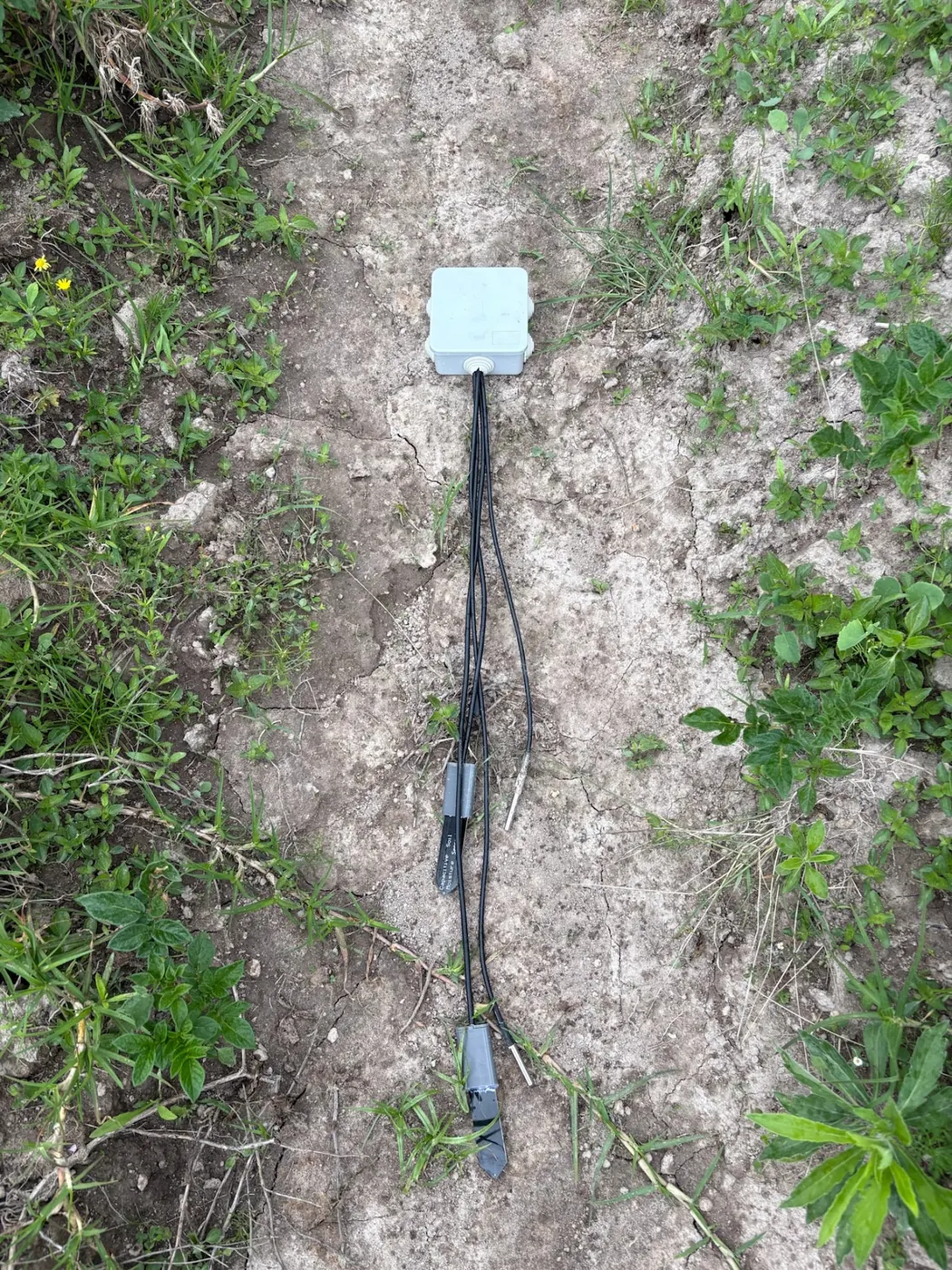
Soil readings from the same period show why this matters at the root. Averaged across our probes, soil moisture sat at 69 percent of sensor scale, with most readings between 19 and 89 percent, a spread wide enough to include both dry and saturated conditions within the same monthly average. Soil temperature at our probe depths averaged 17.0°C, with the shallower and more variable depth moving through roughly a third more range than the steadier deeper one over the same weeks. None of this predicts what the next storm will do. It describes what already happened, which is a different and more useful thing for deciding what a field needs right now.
Stage, not the calendar, decides what a flooded field actually loses
Put the maize duration disagreement, the wheat critical window, and the six-day threshold together, and a pattern emerges that the drainage-first advice never mentions: what stage the crop is at when the water sits matters more than how many days the water sits there. Maize hit at the three-leaf stage carries a different risk profile than maize hit during grain fill. Wheat between its seventh leaf and flowering is at its most exposed window, a stretch that has nothing to do with calendar date and everything to do with where the crop is in its own development.
This is the practical failure in treating get the water off within 48 hours as a universal rule. It applies the same urgency to a field of two-week-old seedlings and a field approaching flowering, when the actual cost of the same waterlogging event is different in each case. A grower who knows which stage each block is at when a storm hits has a better basis for deciding where to spend limited labour on drainage work first, rather than treating every flooded plot as an equal emergency.
Related field observations, on soil temperature ahead of topdressing, are covered in an earlier post on this site, which works through what happens in the soil profile before nutrients go down, a decision that gets harder, not easier, on a field that has recently waterlogged. Nutrient uptake through a stressed root system does not follow the same timeline the topdressing calendar assumes.
Where sensors help and where they cannot
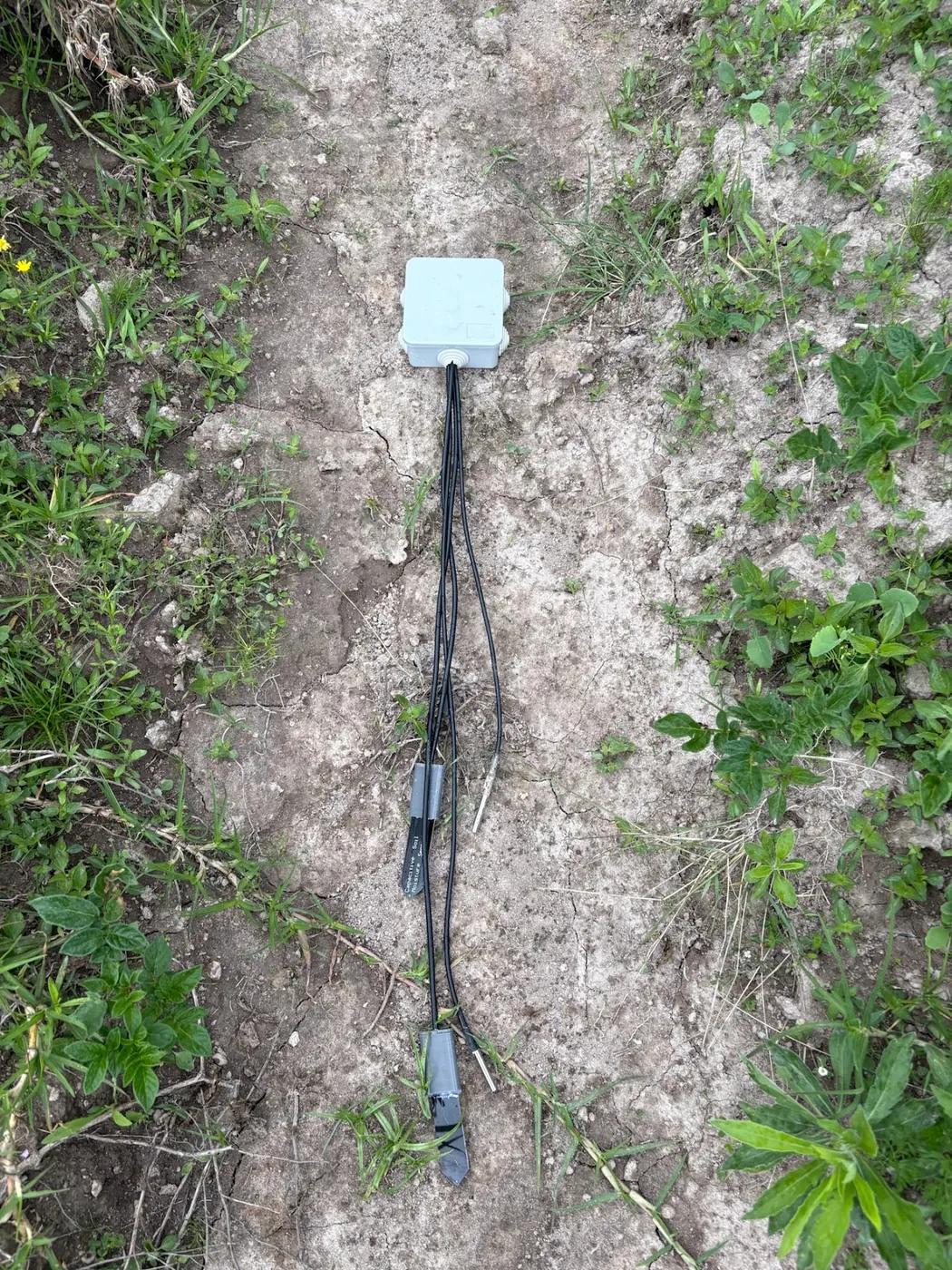
None of the mechanisms above are visible from the edge of a field. A grower cannot see oxygen depletion in the root zone, cannot see whether the deeper soil profile has actually drained even though the surface looks dry, and cannot see whether leaf wetness duration is climbing toward the range that favours fungal spread. Soil moisture sensors placed at a shallow and a deeper depth give a reading of relative moisture on a percent-of-scale basis, which is enough to show whether the deeper profile is still holding water long after the surface has dried, something a hand test in the top few centimetres will not reveal.
A weather station adds the other half: rainfall in millimetres per event, leaf wetness duration computed from the same readings, and vapour pressure deficit, all logged roughly every ten minutes rather than reconstructed from memory after the fact. None of this forecasts the next storm. It tells a grower what actually happened on their own block over the past days and weeks, which is the record a threshold like the six-day waterlogging mark or the three-leaf maize stage actually needs behind it to mean anything locally.
A broader survey of what sensor deployments have and have not delivered for smallholder farms in Kenya covers low-cost technologies growers can actually afford and where mobile-based platforms fit into that picture, useful context for a grower weighing whether instrumentation is worth adding to a block that already floods most short rains seasons. The honest answer is that sensors do not stop a field from waterlogging. What they do is tell you, with a number instead of a guess, how long the root zone actually stayed wet and how close the current stretch is running to the thresholds where yield loss becomes likely.
What the drainage rule gets right, and what it leaves out
Cutting a furrow after a storm is still worth doing. Surface water sitting for days does more damage than surface water gone in hours, and nothing in the research above argues against fast drainage. The failure is treating that action as sufficient, as though the job ends when the puddle disappears. The oxygen debt in the root zone, the stage the crop was at when the water arrived, and the slow salt accumulation that shows up seasons later are three separate problems a single furrow does not touch.
A grower managing more than one block through this season's short rains has a more specific question than is the water off the field: which block is at its most vulnerable stage right now, which one has a deeper profile still holding moisture despite a dry-looking surface, and which one is carrying the longest leaf-wetness stretch this month. Those three questions point to different priorities and different labour, and none of them get answered by walking the field once after the rain stops.
Disease pressure that follows waterlogging is worth its own separate accounting rather than folding it into general wet season caution. A survey of crop pests and diseases in Kenya covers which pathogens actually track rainfall and which track something else entirely, a distinction that matters more once you accept that vector-borne and waterborne risk in comparable studies elsewhere move on opposite calendars, not the same one.