Waterlogging root zone damage gets blamed on the water itself, as if roots simply cannot cope with being wet. That is not the mechanism. Roots die because water fills the pore spaces that would otherwise carry oxygen down to them, and once that oxygen is gone the plant switches its root cells to a form of respiration that cannot sustain it for long. A review of soil waterlogging impacts and mechanisms makes this point directly: the damage is oxygen deficiency triggering anaerobic respiration, not the water itself.
Measured by NuaSense weather stations and soil probes on Kenyan farms, over the period stated with each figure. Past readings, not a forecast.
The pores fill first, and the air goes
Soil is not solid. Between the mineral particles sit pore spaces, and in a healthy, well drained soil those pores hold a mix of water and air. Roots pull oxygen from that air pocket, not from the water film around them. When rain or irrigation exceeds what the profile can drain, water pushes the air out of the larger pores first, then the smaller ones, until the root zone is close to saturated. The Frontiers review frames waterlogging as occurring when soil remains saturated for an extended period, and a companion study on soybean puts a number on that threshold: saturation exceeding 20 percent of field capacity is what qualifies as waterlogging in the soybean root growth study from Nature Scientific Reports. That is not a Kenyan figure, it is a controlled trial condition, but the physical logic transfers everywhere: once the profile sits well above field capacity for an extended stretch, air stops moving through it regardless of where the field is.
On a Kenyan block this stage looks unremarkable from the surface. The soil looks wet, maybe puddled in the low corners, but the crop still looks fine. That gap between what the soil is doing and what the crop shows is the whole problem with waterlogging: the damage starts before there is anything visible to react to.
Respiration switches to a pathway the root cannot sustain
Without oxygen, root cells cannot run the normal respiration pathway that generates the energy a plant needs to take up water and nutrients. They fall back on anaerobic respiration, a backup pathway that produces far less energy per unit of sugar burned and, over time, builds up toxic byproducts. The Frontiers review names lactate specifically: prolonged waterlogging leads to an accumulation of lactate that impairs respiration further, compounding the energy shortage rather than easing it. This is a feedback loop, not a static injury. The longer the root runs on the anaerobic pathway, the worse its capacity to run any pathway becomes.
At the same time, waterlogged conditions raise ethylene production in the plant, and the review notes this impairs physiological functions well beyond the root itself. Ethylene is a signalling hormone, and under normal conditions it helps regulate growth and senescence in useful ways. Under waterlogging it accumulates because it cannot diffuse away through saturated soil, and the plant essentially receives a stress signal it cannot act on.
Why a waterlogged root can wilt like a dry one
One of the more counterintuitive findings in the review is that waterlogged roots can struggle to take up water even while sitting in it. The mechanism is aquaporins, the proteins that form water channels through root cell membranes. Waterlogging reduces phosphorylation of these aquaporins, which lowers root hydraulic conductivity and hinders both water and nutrient uptake. A crop standing in saturated soil can show wilting symptoms that look like drought stress, because the root's plumbing has effectively been throttled shut even though the water is right there.
Nutrient uptake follows the same collapse. The review reports reduced uptake of potassium and calcium specifically under waterlogged conditions. Both are mobile within the plant only if the root can actually pull them in, so a waterlogged crop often shows nutrient deficiency symptoms in the canopy that have nothing to do with what is actually available in the soil solution. Anyone reading leaf colour to diagnose a fertiliser gap on a soggy block is reading the wrong signal, and it is worth cross-checking against when and how fertiliser should actually be applied before topping anything up.
The plant builds its own workaround
Plants are not passive under waterlogging. The review describes three adaptive structures: adventitious roots, which grow laterally near the soil surface where some oxygen is still available; aerenchyma, air channels that form inside root tissue to move oxygen down from the shoot; and lenticels, pores on stems and roots that allow gas exchange. Separately, USDA research on soybean physiology under waterlogging describes flood-stressed plants developing an external root architecture that helps tap atmospheric oxygen and improve aerobic respiration.
These responses take time to build and carry a cost: energy spent on adaptive structures is energy not spent on grain fill or pod set. They also do not fully substitute for a healthy root system working in aerated soil. Genetic work is underway to push tolerance further: the Frontiers review lists genes such as ZmEREB180 in maize and HvERF2.11 in barley that improve waterlogging tolerance when overexpressed. None of that breeding pipeline is available at a Kenyan agrovet counter yet, so for now the crop in the ground is working with whatever tolerance its variety already carries.
How many days before yield actually falls, by crop
This is where the duration numbers matter, and they vary sharply by crop and by which study measured them. In maize, one trial found yield significantly reduced after just 3 days of waterlogging, while a separate 2022 trial found the significant reduction only after 10 days. Both are cited in the same Frontiers review, and the gap between them is the review's own point: duration to damage is not fixed, it depends on growth stage, soil type and how the trial defined waterlogging. Maize is flagged as particularly sensitive at the three-leaf stage.
In wheat, the critical window runs from the seventh leaf of the main stem through flowering, with stem elongation especially vulnerable and grain yield declining as duration increases. Waterlogging during tillering also significantly cuts grain yield. Across growth stages, the review notes that treatments lasting beyond 6 days produce particularly pronounced yield losses in wheat.
Soybean has the most granular data of the three. The Nature Scientific Reports study found waterlogging of 2 to 10 days cutting yield by 25.4 to 47.8 percent in a summer climate regime and 47.0 to 68.2 percent in a rainy regime, with the worst single combination, 45 days after emergence, 10 days of waterlogging, rainy regime, producing a 91 percent yield reduction. The same study found soybean yield losses reaching as high as 83 percent under the most severe combinations tested. None of these figures were measured on an East African vertisol or a Kenyan smallholder plot: they come from controlled trials designed to isolate duration and stage. What transfers is the shape of the relationship, not the exact percentage: duration and growth stage stack, and a rainy background climate makes recovery harder than a sunny one.
Stage beats duration
The soybean study isolated stage S45, 45 days after emergence, as the single most sensitive point, producing a seed yield reduction of about 64.9 percent on its own, before duration or climate are even factored in. That is a bigger single-variable effect than most of the duration figures reported elsewhere in the same trial. Vegetative-stage waterlogging in soybean produced yield reductions of 17 to 43 percent, while reproductive-stage waterlogging produced 50 to 56 percent, roughly double for the same exposure.
The practical read for anyone managing a mixed block is that the same rainfall event can be survivable or damaging purely depending on where the crop happens to be in its cycle when it lands. A short rains storm that catches maize at three-leaf stage is a different risk than the identical storm hitting the same field three weeks later. This is also why a single blanket drainage rule, applied by calendar date rather than by crop stage, misses the point the trials are actually making.
Underground, the losses are already compounding while the surface still looks wet
Root damage compounds through the vegetative growth of the plant, not just at harvest. The soybean study measured reduced root volume, 8.6 percent lower under waterlogging, and reduced root dry weight, down 5.3 percent, alongside a 6 percent drop in leaf area and a 48.2 percent drop in dry matter. Under the more severe combinations, shoot and root dry matter losses climbed to 75 to 77 percent and 64 to 75 percent respectively. Pod counts per plant dropped by as much as 37 percent.
These are not late-season measurements taken at harvest, they describe a plant that has been quietly losing capacity for weeks before the yield figure gets tallied. By the time a farmer notices stunted plants or yellowing leaves above ground, the root system has often already lost a meaningful share of its volume and dry weight. There is no single moisture percentage in this evidence base that flags the exact moment root loss becomes irreversible: the data describes outcomes at fixed durations and stages, not a continuous trace with a warning threshold built in.
Grain fill takes the hit weeks after the water is gone
Maize responds to waterlogging in a way that shows up specifically at grain fill. Under flooded conditions, photosynthesis, transpiration and total dry weight in spring maize all decline, and the review links this directly to reduced yield. More specifically, the maximum grain filling rate decreases and dry matter accumulation falls under flooding. This matters for timing: a maize crop that survives an early waterlogging event without visible damage can still carry a lower grain-filling capacity into the stage where kernel weight is actually set, weeks after the water has drained away.
This is the same reasoning that makes calendar-based topdressing decisions unreliable, a point covered in more depth in a soil moisture reading means nothing until you know three other numbers: a crop can look recovered on the surface while its internal capacity for the stage ahead has already been reduced by an event weeks earlier.
What our own probes recorded during a wet spell
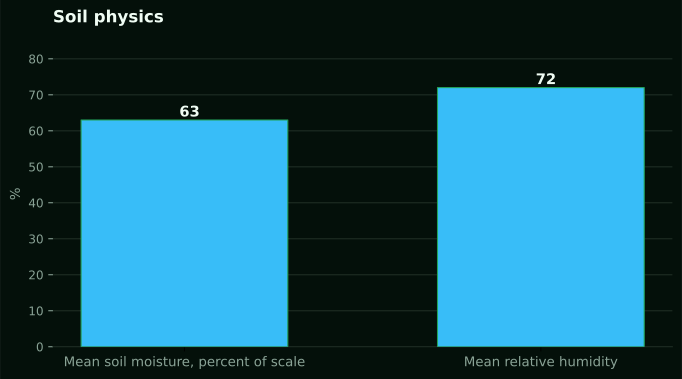
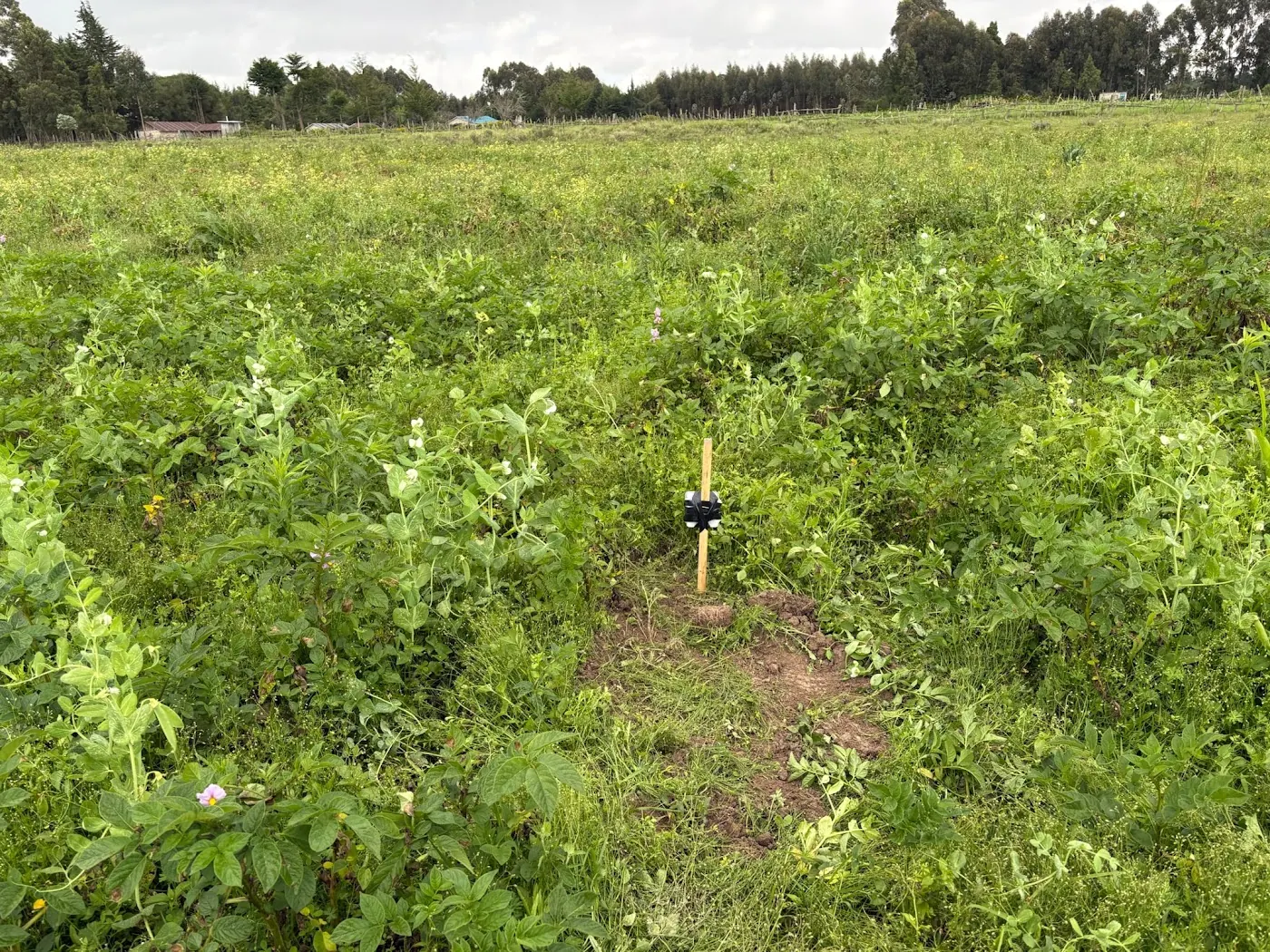
NuaSense soil probes report moisture as a percentage of sensor scale, not calibrated volumetric water content, and readings between 60 and 85 are ordinary on that scale. Across our own network over 31 July to 30 August 2026, soil moisture averaged 63 percent of sensor scale across three probes, with most readings between 18 and 92 percent. That spread across the tenth to ninetieth percentile tells you more than the average does: it shows the same probe swinging from dry to consistently high through a single monitoring window, which is exactly the kind of trace a manager needs to catch before assuming a field has drained when it has not.
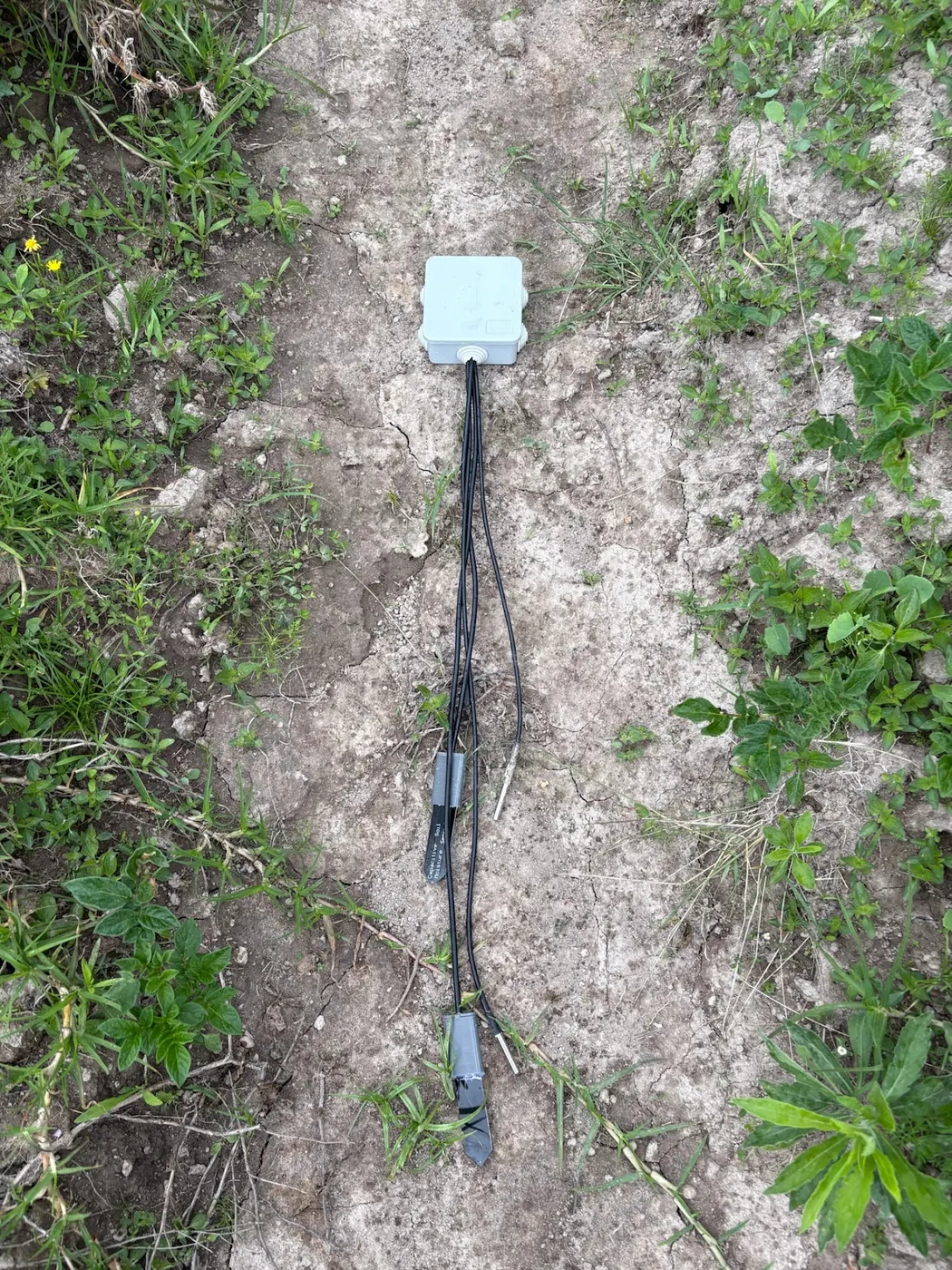
A probe cannot tell you that a root has switched to anaerobic respiration. What it can tell you is how long the shallow and deeper zones have sat elevated, and whether the deeper probe is staying high after the shallow one has come back down, which usually means the profile is draining from the top but still saturated below. That distinction, and how to read a moisture number in context rather than on its own, is the subject of a soil moisture reading means nothing until you know three other numbers.
One station reads 158 mm for the month, another reads zero
Rainfall totals recorded across our own network over 3 to 30 August 2026 ranged from 0.0 mm to 157.8 mm across eight stations, a spread between stations, not a regional average, and the stations are not co-located. That gap alone, over 150 mm between two points in the same monitoring window, is a reminder that a single rain gauge or a single farm's experience of a season says very little about a neighbouring block. The long-term CHIRPS satellite record for the grid cells our stations sit in averages 52 mm for August across 43 years, ranging from a driest year of 24 mm to a wettest of 80 mm. A total of 157.8 mm at one station in a single August is well outside that long-run range for the month, which is the kind of event that puts a field into the saturated condition the trials above are describing, whether or not the crop calendar was ready for it.
Drainage design assumes a survey most Kenyan blocks never had
The engineering answer to waterlogging is drainage, and the FAO module on drainage, flood and salinity control covers the standard toolkit: surface drains to shed ponded water quickly, subsurface drains to lower a perched water table, and land shaping to stop water collecting in low spots in the first place. None of that is exotic engineering, but it requires upfront survey work and, usually, an outlet that can actually carry the water away, which is the part that gets skipped on smaller Kenyan blocks where the field boundary and the drainage boundary were never planned together.
The transfer problem here is not the technology, it is the field size and the equipment on hand. FAO's guidance was written with irrigation scheme design in mind, where a drainage network is laid out at the same time as the canals. A Kenyan smallholder plot rarely has that luxury: drains, where they exist, are often dug reactively after a bad season rather than designed in advance. The honest answer is that there is no single retrofit that closes this gap cheaply, and a grower deciding between reshaping a low corner and simply avoiding planting a waterlogging-sensitive crop there needs to weigh the cost of earthworks against the yield loss figures above, crop by crop.
Sunshine after the flood matters as much as the flood itself
The soybean study found that a summer climate regime, meaning brighter sunshine and higher temperatures, supported better post-stress recovery than a rainy regime, producing higher grain yields for the same waterlogging duration. This is a physiological point about the conditions after the water drains, not a forecast: warmer, drier conditions after a waterlogging event give the plant a better chance to rebuild the root system and resume normal respiration, while continued cloud and rain keep the soil near saturation and stall that recovery. NuaSense does not forecast weather, so this is not a basis for predicting which fields will recover this season, only a mechanism worth knowing when comparing why two similarly waterlogged plots end up with different outcomes.
The failure modes, named plainly
A crop that looks recovered above ground can be carrying reduced grain-filling capacity that only shows at harvest. A field that drains at the surface can still be saturated at depth, invisible without a probe at both depths. A single bad week at a sensitive growth stage, three-leaf maize, tillering wheat, day 45 soybean, can outweigh weeks of otherwise normal management. None of this is fixed by better fertiliser timing or a different variety alone; it is fixed, where it can be fixed at all, by getting water off the field faster than the crop's tolerance window runs out, and by knowing, stage by stage, how short that window actually is.
Also drawn on for this piece: Overview of Water and Soil Nutrient Management under ....