Search for soil temperature germination guidance and you will land on a number: wait until the soil reaches 50 degrees Fahrenheit, which is 10 degrees Celsius, before you plant maize. The figure appears on university extension pages, in seed company leaflets and in the agronomy blogs that copy from both. It is a real recommendation with real research behind it. It was also written for growers in Nebraska and Wisconsin, where the question every April is whether the ground has thawed enough to plant at all.
That is rarely the question on a Kenyan block. Our concern is rarely whether soil will reach 10 degrees at seed depth. Importing a threshold designed to answer a different question gives you a rule that is always satisfied and therefore tells you nothing. Worse, it draws attention to the variable that is not limiting you and away from the two that are.
A trial on maize adapted to semi-arid eastern Kenya, published in Experimental Agriculture, measured which factors actually changed germination and emergence. The answer was soil water content, depth of planting, and the interaction between them, all significant at P below 0.001. One factor that is recommended almost universally showed no significant effect at all.
Where the threshold number comes from
The American figures are not arbitrary. A University of Nebraska extension note gives the working rule: corn and soybean are safe to plant at 50 degrees Fahrenheit soil temperature or greater, while sorghum requires 55 to 60 degrees Fahrenheit or greater. A horticultural table from the University of Wisconsin puts crop-by-crop minimums alongside optima: corn has a minimum of 55 degrees Fahrenheit and an optimum of 95, beets a minimum of 45 with an optimum of 85, tomato a minimum of 70, beans a minimum of 72 with an optimum of 80.
Convert those to Celsius with (F - 32) x 5 / 9. Corn: (55 - 32) x 5 / 9 = 12.8 degrees Celsius. Beans: (72 - 32) x 5 / 9 = 22.2 degrees Celsius. Beets: (45 - 32) x 5 / 9 = 7.2 degrees Celsius. Already the picture is more complicated than one number: within a single vegetable garden, beets will start at 7.2 degrees while beans sit on their hands until the soil is fifteen degrees warmer.
So the first thing wrong with the popular version of the advice is that it collapses a crop-by-crop table into a single figure. The second is subtler and matters more.
The threshold only governs the first day
The Nebraska note is precise about when temperature does its work. Soil temperature above the threshold during the first 24 hours after planting is what matters, because that is the imbibition phase, when the seed takes up water. After imbibition, corn and soybean seeds tolerate temperatures below 50 degrees Fahrenheit without germination being affected, as long as the seed sits in proper soil moisture.
Read that carefully and the rule stops being a planting-date rule and becomes a one-day risk assessment. The grower is not being told to wait for a warm season. They are being told not to put seed into cold ground on the specific day it goes in, because a chilled seed drinking cold water is where the damage happens. A cold snap on day four is a different situation entirely.
For a Kenyan planting window, that reframing is the whole point. The imbibition risk is negligible here. What happens on day four, and day nine, and day fourteen, is not.
What the eastern Kenya trial measured
The Experimental Agriculture study worked with maize adapted to semi-arid eastern Kenya and produced the numbers a threshold rule cannot give you. Germination rate increased up to an optimum temperature of 33.6 degrees Celsius, above a base temperature of 6.1 degrees Celsius. Above the optimum the rate fell away, reaching zero germination at 42.9 degrees Celsius.
Measured in the Experimental Agriculture trial. These are thermal parameters for germination rate, not planting instructions.
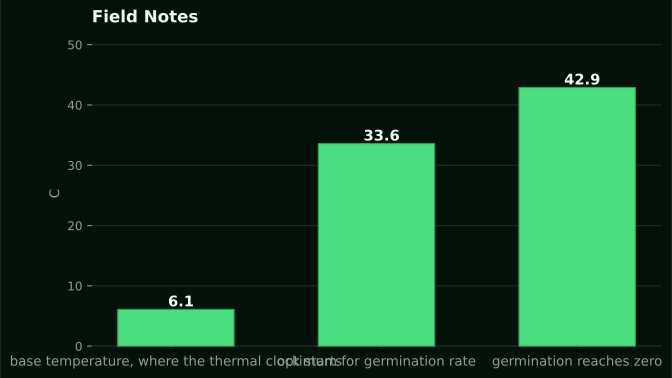
Those three temperatures are easy to misuse, so it is worth being exact about what they are. A base temperature is the point at which the thermal clock starts running, not a threshold below which you must not plant. Degree-day accumulation above 6.1 degrees Celsius is what drives the seed forward. Nobody in eastern Kenya is waiting for 6.1 degrees. The number matters because it defines the scale on which every other figure in the study was calculated.
The upper figure deserves more attention than it usually gets. Zero germination at 42.9 degrees Celsius is not a theoretical ceiling in a country where bare soil surfaces get hot. A separate study on soybean recorded soil temperature at 5 centimetres ranging from 26.6 to 44.6 degrees Celsius under polythene mulch, and no germination occurred at all, with fungus attacking the seed 59 hours after sowing. Different crop, different cover, but it shows that the top of the range is reachable under a sheet of plastic in the sun.
The mulch result that contradicts the standard advice
Here is the finding that should change how the advice is written. In the eastern Kenya maize experiment, mulch, or any interaction involving mulch, had no significant effect on germination and emergence.
Mulching is recommended almost reflexively, and for good reasons that have nothing to do with germination: it holds moisture through the season, it suppresses weeds, it feeds organic matter back into the soil. Those benefits are real and they are why the practice is worth doing. But if you are mulching because you believe it will get your maize out of the ground faster or more reliably, this trial found no evidence for that, in the conditions it tested.
The soybean work points the same direction from a different angle. A soil temperature regime of 24.2 to 32.8 degrees Celsius, created by 5 tonnes per hectare of straw mulch, was optimum for germination in that experiment, while polythene over the same soil pushed temperatures to 44.6 degrees and killed the stand. The cover material decided the outcome, not the presence of cover. Straw moderated, plastic cooked.
So mulch is a lever on soil temperature, and levers move in both directions. Assuming it helps germination because it helps other things is the kind of substitution that survives in agronomy writing precisely because it sounds reasonable.
What did move emergence: depth and water
The two factors the Kenyan trial found significant are both under your direct control at planting, and both have a price attached in the same currency: thermal time, measured in degree-days.
Increasing planting depth by one centimetre increased the thermal time required for emergence by 2.8 degree-days. Decreasing soil water content by 1 percent increased it by 3.2 degree-days. Median germination itself needed more thermal time as soil got drier, rising from 51.5 degree-days to 56.4 degree-days as soil matric potential fell from minus 5 to minus 40 kilopascals.
Put those together on a real seedbed. Plant three centimetres deeper than you meant to, chasing moisture, and you have added 3 times 2.8, which is 8.4 degree-days to emergence. Do that into soil that is 2 percent drier than you assumed and you add 2 times 3.2, another 6.4, for a total of 14.8 degree-days on a germination requirement that starts around 51.5. Divide 14.8 by 51.5 and the delay is 28.7 percent in thermal terms, arrived at through two decisions that both felt like good practice at the time.
Deeper planting into dry soil is a rational response to a dry seedbed. The trial's contribution is to price it, so the decision stops being a hunch.
Borrowed numbers and the crops they came from
One more trap sits in this topic, and it catches careful people. Soybean research gives a clean optimum: 28 degrees Celsius in a sandy loam soil, with optimum soil moisture between 10 and 15 percent, and at 28 degrees the time required for 75 percent germination was 71 hours at 5 percent soil moisture, 47 hours at 10 percent, and 35 hours at 15 percent.
Those are excellent numbers. They are also soybean numbers, from a sandy loam, and the maize optimum from eastern Kenya is 33.6 degrees Celsius, more than five degrees higher. A figure quoted without its crop and its soil is a figure that will eventually be applied to the wrong field. When you read a germination temperature anywhere, including here, the first question is which crop it was measured on and the second is which soil.
The moisture percentages carry the same warning in a sharper form. Ten to fifteen percent in that soybean study is a volumetric measure of a specific sandy loam. It is not a number you can read off a sensor and compare, which brings us to what your own instruments can and cannot tell you.
Rain closes the window before heat does
Work on dry forest species in the Brazilian Caatinga modelled what happens to germination under climate scenarios, and the result reorders the whole question. Under the most pessimistic scenario, soil temperature rises 3.9 degrees Celsius and rainfall drops 30 percent. Even so, soil temperature is never lower than the minimum and seldom higher than the maximum thresholds for germination.
Temperature, in other words, stays inside the workable band. What fails is water. Germination can happen in a single day provided moisture requirements are met, at 0.139 cubic centimetres per cubic centimetre in that system, and the minimum weekly rainfall for germination is estimated at 17.5 millimetres. That much rain currently falls in 14 weeks of the year at that site. By 2055 the model puts it at 4.
A different continent and a different flora, so the figures do not transfer to Machakos or Kitui. The structure of the finding does, and it is worth stating plainly: in a drying climate, the germination window is set by rainfall weeks, not by degrees. If you are watching only temperature, you are watching the variable that was never going to stop you.
Why the table on the page is not the temperature in your field
Every number above was measured somewhere else, by someone else, in a soil that is not yours. That is normal and it is how agronomy works. But it puts a hard limit on how far a table can take you, and the limit shows up in two ways.
Soil temperatures change more slowly than air temperatures, because of soil mass and moisture content. A weather forecast that says the night will be cold is not telling you what the seed will experience. In Central Jersey commercial vegetable fields, soil temperatures on April 15 were 56 to 58 degrees Fahrenheit, and a later sampling found 48 to 52 degrees, nearly ten degrees cooler, despite warmer air temperatures. Residue makes its own difference: in west-central Nebraska, fields with wheat residue under dryland management had the highest daily soil temperature at 1.75 inches depth, and corn residue under irrigation had the lowest.
Two fields on the same farm, same week, same air, and a spread in soil temperature wide enough to change a planting decision. No table resolves that. Only a measurement in that soil does.
What a probe in your own ground actually tells you
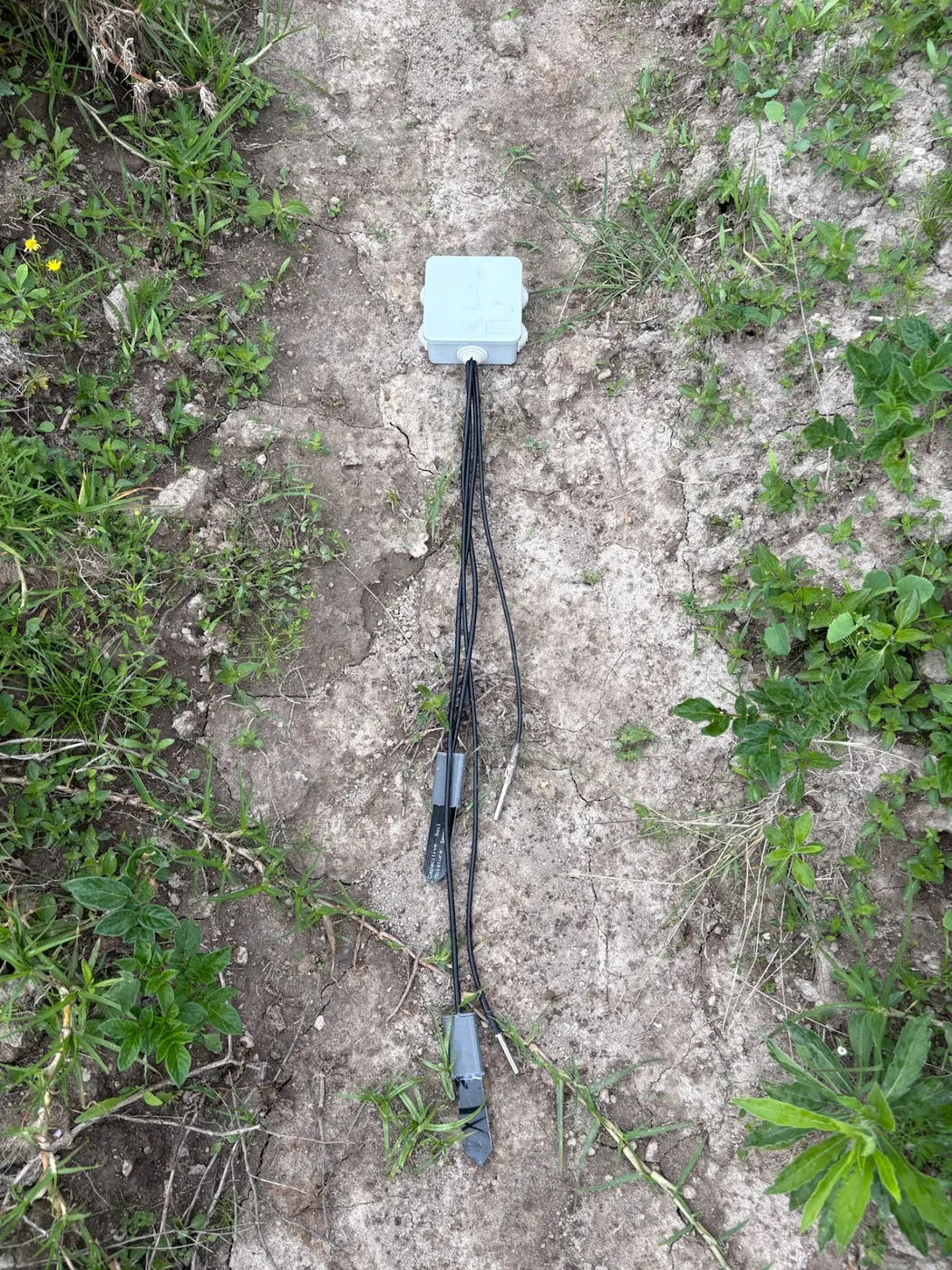
This is where a sensor earns its place, and it is worth being exact about what it does and does not give you. Our LoRaWAN soil probes measure at two depths, a shallow and a deeper position, and each depth carries both a moisture and a soil temperature channel. They send an uplink roughly every ten minutes, over LoRa, independently of the weather gateway.
The temperature reading is the straightforward half. It is degrees Celsius at the depth you buried the probe, sampled through the day, so you see the daily swing rather than a single spot check taken whenever you happened to walk the field. Against the eastern Kenya figures, that is enough to answer real questions: is the seed zone spending part of the afternoon near the upper end where germination rate falls away, and how much of the day sits near the 33.6 degree optimum.
The moisture reading needs a caveat that most sensor marketing skips. Our probes report relative moisture as a percent of sensor scale, not calibrated volumetric water content. Readings of 60 to 85 are normal on that scale. You cannot take the soybean study's 15 percent and compare it to a probe reading of 15, because they are not the same quantity. What the probe gives you is the shape and the direction: whether the seed zone is drying, how fast, and how the two depths diverge after rain. Turning that into millimetres means calibrating against your own field capacity, which is a separate job with a separate method.
For the depth-and-water penalty the Kenyan trial priced, direction and rate are most of what you need. If the shallow probe is falling and the deeper one is holding, planting shallow into a drying layer is a different bet than the same depth would be a week earlier. Our writeup on what a soil moisture reading means covers how to read those two curves against each other.
What this changes about when you plant
The threshold rule is not wrong. It answers a question about cold spring soil that Kenyan growers mostly do not have, and it answers it for the first 24 hours only. Carried across the equator it becomes a rule that is always satisfied, which makes it feel like a check that has been passed rather than a check that was never relevant.
What the eastern Kenya maize trial puts in its place is less tidy and more useful. Soil water and planting depth are what moved emergence, they interact, and each carries a measurable cost in degree-days: 3.2 per percent of water lost, 2.8 per centimetre of depth added. Mulch, in that trial, did not move germination either way, whatever else it does for the season.
For a farm with sensors in the ground, the practical shift is small and specific. Stop asking whether the soil has crossed a temperature line. Ask instead how much thermal time the depth you are about to plant at will cost you, given how dry the seed zone actually is this week, and whether the afternoon peak in your own field is heading toward the range where germination rate starts falling instead of rising. Broader soil health work, the kind covered in NuaSense's piece on declining soil health in Kenya, changes the water-holding side of that equation over seasons rather than days, and it is the slower lever behind the same number.
None of that requires a new rule to memorise. It requires knowing two curves in your own soil, which is a smaller ask than the internet's confident single number, and considerably harder to get wrong.
Also drawn on for this piece: Effects of Temperature, Soil Water Status and Depth of Planting on Ger; Effect of temperature on soybean germination; Rainfall, not soil temperature, will limit the seed germination of dry.
Related reading on this site: soil temperature sensors, soil moisture sensors.
NuaSense has a longer piece on this: How to Increase crop yields in Kenya covers Kenya's crop yields are a fraction of what's possible. This guide covers the soil fixes, water strategies, seed choices, and precision tools that are already making the difference for Kenyan farmers.
Also drawn on for this piece: Using Soil Temperature Windows for Corn and Soybean; When Is the Right Time to Plant Vegetable Seeds? Check Soil ...; Soil Temperatures and Seedlings - Plant & Pest Advisory; Using Soil Temperature Windows for Corn and Soybean.