Electrical conductivity is an indirect measure: it tells you how many dissolved ions are in a solution, not which ions or how much of each. It is used across high tunnels, greenhouses and ornamental nurseries, and Kenyan growers running coir slabs, rockwool or soilless bags increasingly install an ec sensor greenhouse setup alongside soil moisture sensors to decide when and how much to fertigate. The trouble is that most people treat the number on the screen as ground truth. It is not. It is the output of a chain of physical events, and if you understand where each one can go wrong, you stop making irrigation decisions on a number that is quietly lying to you.
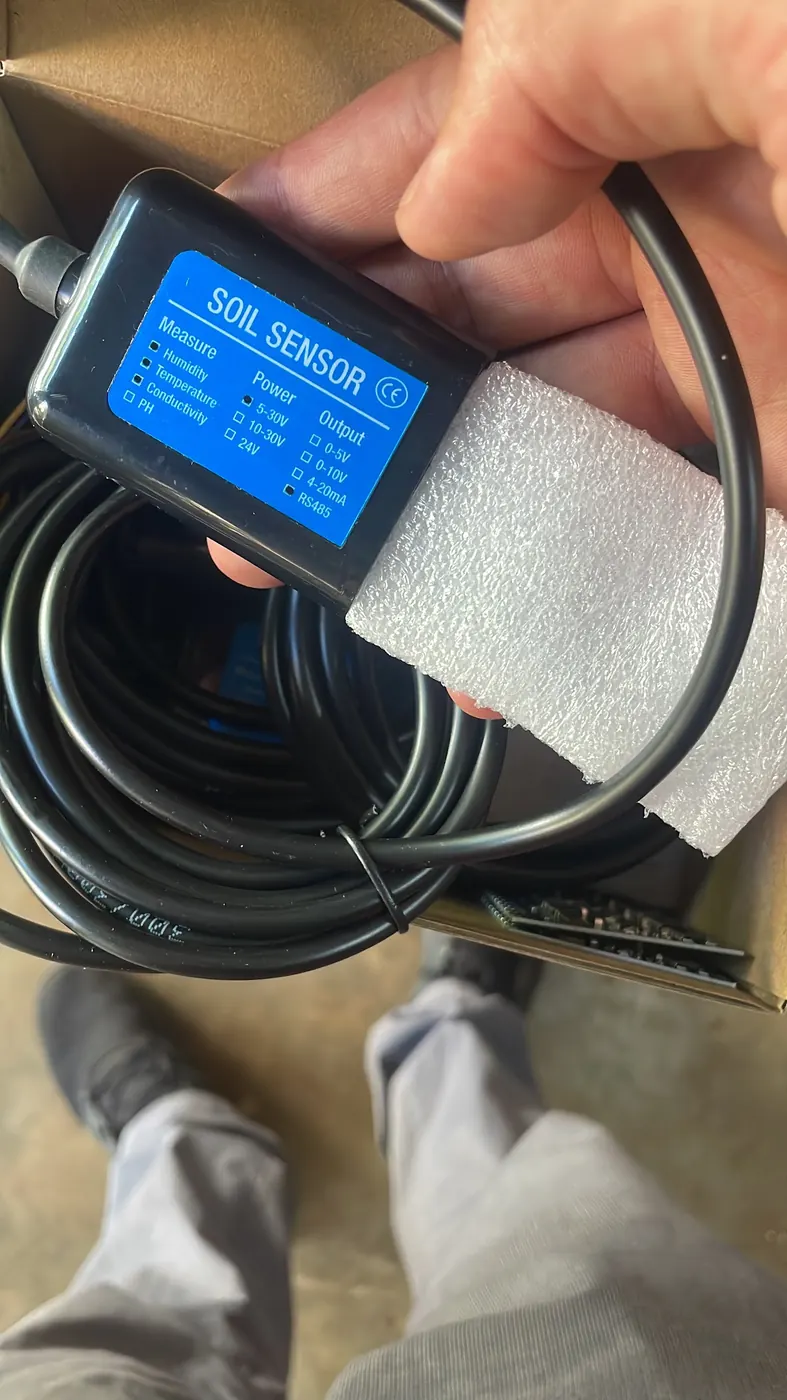
Current passes between two electrodes in the medium
An EC probe works by pushing a small alternating current between two electrodes and measuring how easily that current moves through the water surrounding them. Pure water barely conducts. Dissolved salts, mostly the nitrate, potassium, calcium and other ions from your fertigation mix, carry the current. More ions, less resistance, higher EC. This is why EC is described in the Purdue Extension guidance as an indirect measure of dissolved ion concentration rather than a nutrient-specific reading. It cannot tell you whether the salts are nitrogen you want or sodium you do not. Two solutions can carry identical EC with completely different fertility value. On a Kenyan greenhouse tomato or capsicum block dosing through a fertigation tank, this matters because a grower who chases a target EC number without ever testing the actual nutrient ratio can hold conductivity steady while the crop quietly runs short on one element and long on another. The electrode gap and the current frequency used inside the probe are fixed by the manufacturer, which is one more reason two different sensor brands reading the same solution will not always agree exactly, even when both are working correctly.
The reading depends entirely on what is touching the electrodes
FAO's good agricultural practice guidance for greenhouse vegetable crops notes that some dielectric soil moisture sensors report bulk soil EC as a side output of the same capacitance measurement used for moisture. Bulk EC is a mix of the water's conductivity, the medium's own particle conductivity, and how much water is even present. This is the point where growers get caught out. A dry patch of coir with high salt concentration and a wet patch with lower salt concentration can report similar bulk EC, because the sensor cannot separate the two contributions on its own. The fix in the research literature is not a smarter algorithm, it is calibration against the actual medium you are using, which brings us to the question that decides whether any of this is usable at all. A probe sitting half in an air pocket inside a loosely packed slab will also report a value that has nothing to do with either water or salt content, simply because the electrode contact itself is poor.
Manufacturer calibration is a starting guess, not a fact
Research on ECH2O EC-10 and EC-20 capacitance sensors installed in coir found that the manufacturer's factory calibration equations mostly underestimated volumetric water content. An AGRIS trial of tomatoes and cucumbers grown in coir found that when researchers ran a coir-specific calibration on each individual sensor, the prediction became close to perfect. The same paper describes a rapid calibration procedure that worked accurately across the plant-available water range in coir and corrected for the variation between individual sensor units. Two things follow for a Kenyan grower. First, if you are running coir slabs and trusting the out-of-the-box calibration on an EC or moisture sensor, you are almost certainly reading a number that is systematically off, not randomly off, which is worse because it looks consistent and trustworthy. Second, that calibration study covered coir specifically. It says nothing about how a rockwool slab, a peat mix or open soil behaves under the same factory curve, and no source here tested those media. Do not carry the coir correction over to a different substrate just because it is the only calibration figure available. If you cannot run a lab-grade calibration yourself, at minimum log the sensor's reading against a known reference solution once at installation, so you have a starting offset to work with rather than a blind guess.
Placement decides whether you are measuring the crop's water or the drain
According to Springer's guidelines for measuring and reporting environmental parameters, greenhouse environments have real spatial and temporal variability, and sensor placement has to be chosen deliberately rather than wherever a cable happens to reach. In a coir bag system this plays out as a genuine dilemma: put the EC probe near the emitter and you read the fresh irrigation pulse; put it near the drain hole and you read what the crop rejected. Neither is wrong, they are answering different questions. The same guidance recommends multi-point calibration rather than a single reference point, precisely because a sensor's response is rarely linear across its whole working range. For a Kenyan greenhouse operator with one or two EC probes per block, the practical decision is to fix the position deliberately, document it, and stop moving the probe between visits, because a moved probe generates a step change in the data that looks like a nutrient event and is not one. Choose the emitter side if your question is dosing accuracy, and the drain side if your question is leaching and salt buildup, but decide before you install rather than after you see a strange trace.
The number only becomes a decision once it is tied to a depletion rule
Trials on greenhouse coir-grown tomatoes and cucumbers scheduled irrigation to different pre-set depletion levels of available water rather than watering on a fixed clock. An AGRIS trial of tomatoes and cucumbers grown in coir found that scheduling to the highest depletion level cut irrigation by 427 L per square metre in small bags and 487 L per square metre in large bags for tomatoes, and by 124 and 240 L per square metre respectively for cucumbers, compared to a well-watered control, while yield was maintained or improved at around 60 percent depletion of available water content. The well-watered treatment in every one of those trials produced what the researchers called luxury water use: the plant took up water beyond what growth required, and the extra volume did not show up as extra yield. But the same study found the ceiling was not the same for every bag size: for large bags the depletion level beyond which yield actually dropped was 85 percent for tomatoes and 70 percent for cucumbers, and the researchers explicitly said the small-bag depletion approach is not yet recommended, only the large-bag one. An EC reading on its own does not tell you where you sit on that curve. It has to be read alongside a moisture or depletion measurement, and the two together are what let you cut irrigation volume without cutting yield.
What changes between a research greenhouse and a Kenyan block
The depletion trial above was run in controlled glasshouse conditions, almost certainly with tighter climate control and more uniform bag placement than a typical Kenyan polytunnel gets. A Kenyan grower running coir bags under a simple polythene structure, with a manual or basic solenoid fertigation controller rather than a lab-grade dosing rig, will see more variability between bags than the trial reports, because ambient temperature swings and uneven drip emitter output both push bag-to-bag EC and moisture apart. That does not make the 427 L and 487 L figures useless. It means treat them as evidence that depletion-based scheduling has real headroom, not as a number to copy onto your own irrigation timer. The right move is to run your own EC and moisture readings for a season using soil moisture sensors placed consistently across representative bags, watch where your bags actually sit relative to the 60 percent depletion mark the trial used, and adjust from there. Nobody has published that baseline for Kenyan coir greenhouse operations yet, which is itself worth stating plainly rather than papering over with an invented figure. Two seasons of that kind of record, kept in a simple spreadsheet against the sensor's own readings, will tell a grower more about their specific block than a borrowed foreign figure, because the borrowed figure was never measured under a Kenyan roof, a Kenyan fertigation pump or a Kenyan dry season.
The colour-coded alternative and where it stops
Not every Kenyan grower needs a quantitative EC probe on day one. According to AICCRA/CGIAR's report on tech-backed irrigation changing the livelihoods of farmers in Eastern and Central Africa, the Visualising and Interpreting Agronomic data (VIA) programme's first phase ran from 2015 to 2019, testing low-cost chameleon soil moisture sensors, a Wi-Fi system and wetting front detectors in Malawi and Tanzania as a CSIRO and ACIAR research partnership, with a second phase from 2020 to 2023 expanding the programme into Malawi, Mozambique and Zimbabwe. The chameleon sensors themselves simply turn blue, green or red depending on whether soil is too wet, adequate or too dry, and they do not measure EC. A separate soil conductivity meter is included in the wider VIA toolkit and gives a quick reading of overall soil nutrient and salt levels alongside the moisture colour code. By 2024, more than 87,000 VIA sensors had been distributed to project partners in over 24 countries, though the source does not break that total down by device type, so it should be read as a scale figure for the programme rather than a count of EC meters specifically. The income results reported from the programme, including one Ugandan farmer pair earning USD 8,276 against a national smallholder average of USD 795, and another farmer moving from USD 285 to USD 6,564 on one acre, are attributed to the broader VIA toolkit in the source, not isolated to EC readings alone. For a Kenyan grower starting out, the honest path is colour-coded moisture monitoring first, a standalone EC meter next, and a slab-embedded EC sensor with proper calibration only once the block's fertigation volume justifies the extra discipline it demands.
What a commercial IoT platform adds, and what it does not prove for Kenya
FAO's Agritech Observatory profile of PlastenikNET describes an IoT greenhouse platform running in Bosnia and Herzegovina, Serbia and Greece that measures soil EC alongside temperature, humidity, moisture, pH, wind, rainfall and solar radiation, sampling every ten seconds, and notes that as of May 2026 it supported more than 50 installations in greenhouses from around 100 to 300 square metres, priced from EUR 290 to EUR 2,590 for full monitoring and control. The platform reports that running several short irrigation cycles a day instead of one long soak reduces tomato fruit splitting and raises marketable yield share. Nothing in that source says the system is sold or installed anywhere in Kenya, and the price band quoted is for a European market, not one you should assume transfers directly given import duty, currency and support-cost differences. The transferable idea, not the price tag, is the multi-cycle irrigation logic: shorter, more frequent watering events read against real-time EC and moisture data rather than one big daily dose. A Kenyan grower can apply that logic on a much cheaper local timer and dosing pump, provided the moisture and EC readings feeding the decision are trustworthy in the first place, which loops back to calibration and placement above.
Documenting the sensor, not just reading it
Springer's guidelines for measuring and reporting environmental parameters recommend recording the equipment model, manufacturer, town and country of manufacture, stated precision and accuracy, the calibration procedure used, and the date of the most recent calibration, whenever those details matter to interpreting the data. Those same guidelines suggest calibrating before and after a trial period so that any drift over the season can be spotted and factored into the analysis, and they recommend using an independent set of sensors for verification separate from the ones running your control loop, because a control sensor can fail quietly even after routine servicing. A commercial greenhouse is not a research trial, but the discipline still pays. If your EC probe reads a sudden spike, the first question is not what changed in the crop, it is when the probe was last checked against a known reference solution. Kenyan growers rarely have lab access for that, but a simple two-point check against a fresh and a spent nutrient solution, done at the start and again mid-season, catches most drift before it costs a crop cycle. Writing these details down in a notebook next to the fertigation log costs nothing and turns a mysterious spike into a solvable question worth revisiting the next time the trace looks strange.
Where the platform ends and the pipework begins
NuaSense's deployed soil sensor fleet reports relative moisture on a percent-of-scale basis at a shallow and a deeper probe, each also carrying a temperature channel, uplinking independently over LoRa roughly every ten minutes. EC is offered as a NuaSense product but is not currently streaming from the deployed soil fleet, so a Kenyan grower wanting live EC data today needs a standalone meter or slab probe alongside the moisture and weather layer, not instead of it. What the weather station and moisture data already give you: hourly reference evapotranspiration, dew point, vapour pressure deficit, leaf wetness duration and a spray window score, all computed from station readings rather than separate sensors. None of that replaces an EC reading, but it does tell you when the crop's water demand is rising, which is exactly the condition under which a depletion-based EC and moisture strategy like the coir trial above starts to pay off. NuaSense sells the sensing and data layer, not irrigation pipework, so pairing a fertigation system's own EC controller with an independent moisture feed for cross-checking is the practical setup, echoing the guidance to keep monitoring and control sensors separate. More background on how this fits into a wider water strategy is covered in NuaSense's overview of smart irrigation in Kenya, which walks through drip system water efficiency and low-cost gravity-fed kits.
The baseline problem: modelled soil data is not a field test
Soil texture, pH and water holding capacity baselines used to size a new gateway deployment, whether from iSDA Africa or SoilGrids, are modelled map values from around 2016, fetched once when a site first reports its position. They are a starting estimate for the general area, not a soil test of the actual bed or bag you are fertigating. This matters directly for EC interpretation, because the same conductivity reading means something different in a coir slab than in a mineral soil with naturally higher background salinity. A grower moving from an open-field block onto raised coir bags cannot assume the EC targets that worked in the field will hold in the bag; the calibration research on EC-10 and EC-20 sensors makes the same point from a different angle: it corrected for coir specifically because factory equations designed for generic media misread it. Whatever your medium, treat the manufacturer's default curve and the modelled soil baseline as first guesses to be checked, not settings to trust unread. A gateway's modelled baseline is a reasonable starting point for planning a deployment, alongside soil moisture sensors that read the actual bag or bed, but it should never be the only number a fertigation decision rests on once the crop is in the ground.
Reading bulk EC as if it were nutrient concentration
The most common misuse is treating a bulk EC number as a direct fertility reading. It is not; it is influenced by moisture content, temperature and the electrode-medium contact as much as by dissolved nutrients (Horticulture and Landscape Architecture; Good Agricultural Practices for greenhouse vegetable crops). A grower who sees EC climb and responds by cutting the fertigation dose may actually be watching the medium dry between irrigation cycles, concentrating existing salts rather than signalling nutrient excess. Cross-check any EC spike against the moisture reading from the same point before changing a dosing recipe. This is precisely why the depletion trial paired conductivity thinking with a measured available-water fraction rather than a conductivity number alone: without the moisture context, a rising EC trace is ambiguous by design, not by sensor fault. The failure is rarely the hardware. It is the decision made on half the available evidence, and it is an easy trap to fall into when the dashboard only shows one line on the chart.
Trusting factory calibration in coir or any uncalibrated substrate
The EC-10 and EC-20 coir study is explicit that manufacturer equations mostly underestimated volumetric water content, and only individual sensor calibration in the specific medium gave a near-perfect fit. That correction is documented for coir. It has not been validated here for rockwool, peat blends or field soil, and carrying it across media without testing is exactly the kind of shortcut that produces confidently wrong irrigation decisions. A grower switching media mid-season, say from an open bed trial into coir bags for a new crop cycle, should treat the changeover as a reason to recalibrate rather than a reason to keep the old settings and hope the sensor adjusts on its own. The recalibration itself does not need a laboratory: soaking a sample of the actual growing medium to a known saturation point and comparing it against the sensor's raw output gives a usable correction curve, closer to what the trial did than most growers assume, and it costs an afternoon rather than a shipment to a lab overseas.
One probe, one position, no record of when it moved
A single EC probe fixed near an emitter reads irrigation pulses; moved to the drain zone it reads rejected salts. Both are valid, but a probe repositioned between visits without a note produces a data step that looks like a real agronomic event. Multi-point calibration and a documented placement history, as recommended in the greenhouse measurement guidelines, are what separate a usable dataset from a misleading one over a full cropping season, and it is a habit worth building into any Kenyan greenhouse's routine before the sensor budget grows past one probe. The cost of skipping this is not abstract: a mid-season EC jump that is really a probe move can trigger a wasted fertigation adjustment, and by the time the mistake is spotted a stretch of the crop's nutrient history has already been recorded against the wrong baseline. Further background on affordable sensor choices for Kenyan farms sits in the practical IoT applications piece, which covers low-cost sensor options suited to smallholder budgets rather than research-grade rigs.
None of the three failure modes above needs new hardware to fix. They need a written record of what the probe is doing, where it sits, and when it was last checked, which costs a notebook and ten minutes a week, not a bigger sensor budget. The mechanics matter more than the marketing copy on the box: a correctly calibrated, well-placed, well-documented EC probe on a modest budget will outperform an expensive sensor installed carelessly and never checked again.
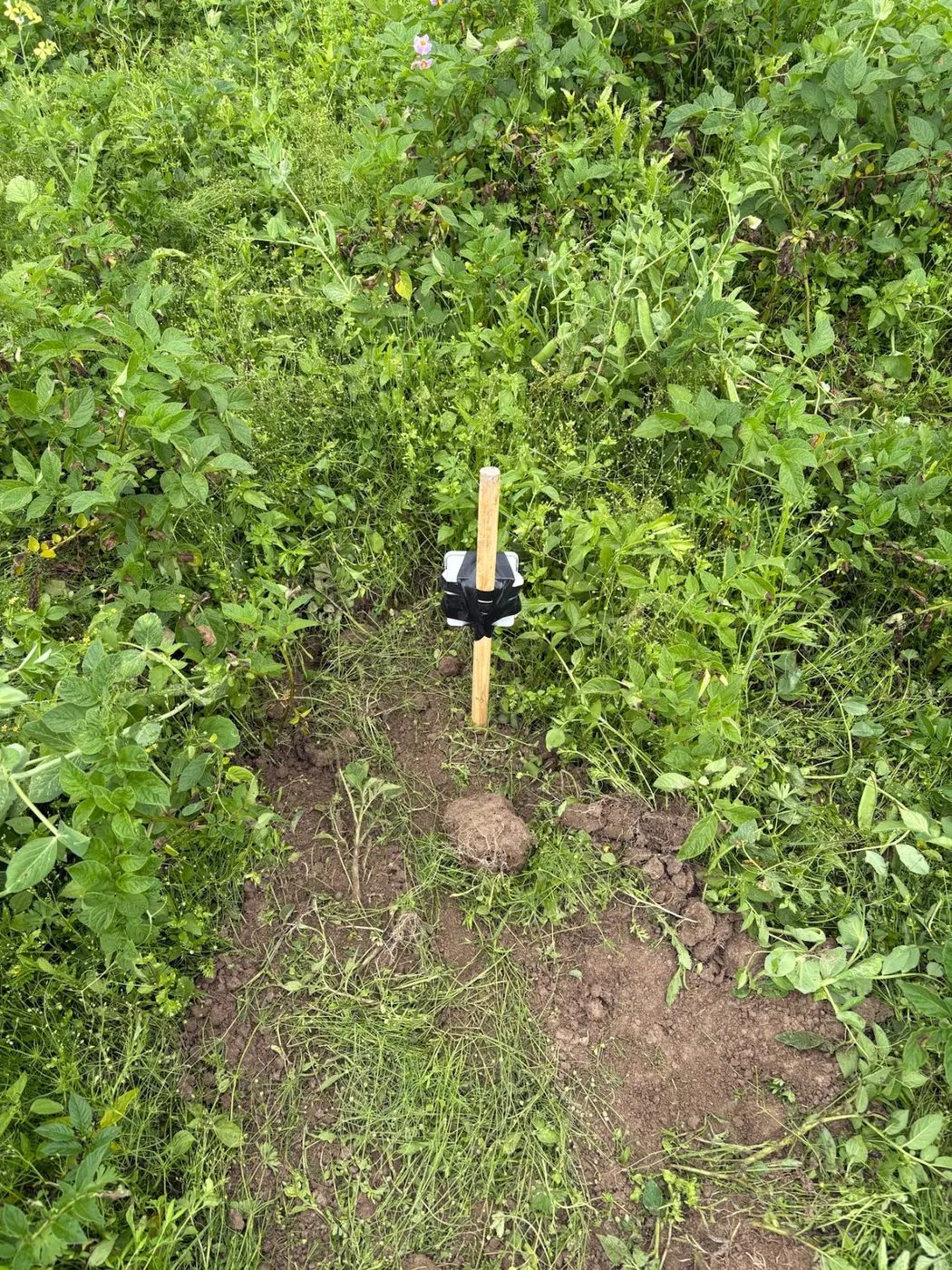
NuaSense builds the hardware behind these readings: LoRaWAN soil probes at two depths, a weather station, and the dashboard that ties them together. See what NuaSense offers.